
042 | Anarchy is Utopia
Stories of life, philosophy, anarchy, and of bumping my head

My favourite thing about the cafe at Books Upstairs on D’Olier Street is that they have only two tables designated for people to use laptops and tablets.
They enforce that rule strictly.
On a recent visit to Bangalore in September 2025, I’ve seen coffee shops robbed of all their chill when overrun by tech bros.
“Everywhere you go, you always take your office with you”.
I confess that when I worked in an F&B start-up in 2011-12, I parked myself at coffee shops too. My thoughts on how I’d like to operate in public spaces and how I’d like to spend my precious time has changed since.
The Books Upstairs cafe is a place where I’ve lost myself in a good book for hours on end. I’ve written verse after entering flow state. I know that each time I go there, no matter what, I will leave the place feeling better than I did before I stepped in.
This particular time was no different. The cafe was full. The barista, Gráinne, told me I could share tables with someone else if they were open to it.
So I made my way towards a corner table where a man was sitting with a book.
As I adjusted my chair, I bumped the back of my head against a shelf protruding from the wall. It hurt badly. I could tell because the sound of my head making impact caused a few people around to pause and give me concerned looks.
The man at the table set his book down and inquired if I was okay.
It took me a minute to reorient myself and establish that there was no bleeding, much to my relief.
Hip-Hopera and Time Travel
I wrote a musical, a hip-hopera and brought it to stage in February.
Run time - 25 minutes. I’m thrilled I got to do it, and I enjoyed it so much that I will do more of it.
I am writing an expanded version which I pitched to Dublin Fringe for their 2026 program. No dice. I got rejected.
There’s no stopping me.
Making art is about not letting my ego get in the way of rejection, not asking anyone for permission to create what I’d like to and to ensure that what I do what aligns with my purpose - which is to leave people and places better than I found them as best as I can.
I wanted the expanded version of the story to have some elements of time travel. Why not?
I tried a few ways of making that happen through the plot line.
Three approaches stood out at first pass.
One - the protagonist WANTS to travel back in time and somehow manages to make it happen. Kinda like in Back to the Future.
Two - the protagonist is FORCED to travel back in time. Somewhat like It’s a Wonderful Life, but not exactly so.
Three - the protagonist lands in the past due to a CLERICAL ERROR. Very Hitchhiker’s Guide to the Galaxy like.
None of these seemed to line up and make the “click” sound that I’ve previously heard in my head when something feels just right when I wrote.
I began scouting my mind for stories that did interesting things with time, and that’s how I arrived at “Arrival” once again.
Story of Your Life
I re-read “Story of Your Life” by Ted Chiang.
The novella is about a mother who writes to her daughter. The narrative moves between what is going on in their intimate shared life, and what is unfolding in the world around them.
Little stories blend with big stories.
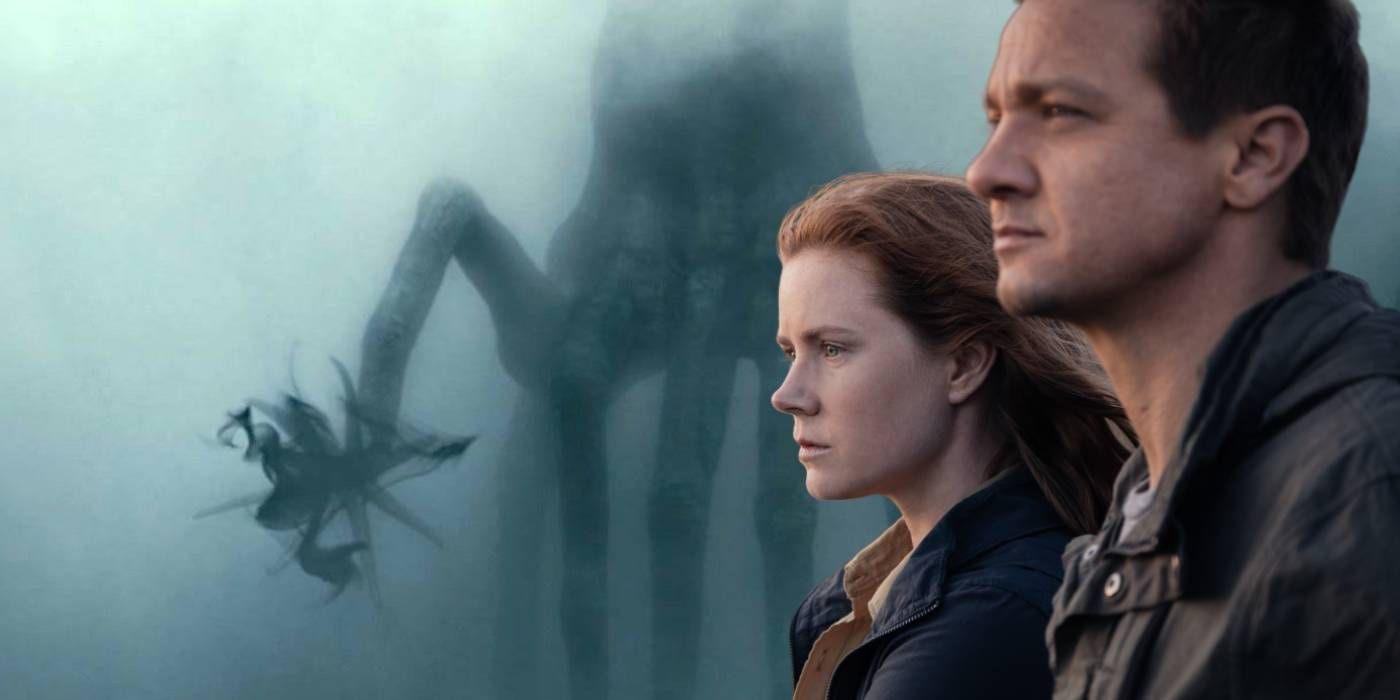
The novella was made into a movie.
Arrival is one of my favourite science fiction movies.
While I love Independence Day and the jingoism that it inspired within teenage Hari, my present self gets more thrills from understanding the actual mechanics of first contact with an alien species.
What language(s) do they speak? How similar to us are they? How can we learn from our differences?
It helps that the protagonist in the story, Dr Banks is a linguist and that she helps humanity decode the language of the aliens. I don’t think I’ve crushed as hard on a fictional character in recent times as I have on Dr. Louise Banks.
There’s something about people with linguistics PhDs, I suppose.
The novella and the movie are both unbelievable, and I recommend them strongly if you haven’t read / watched them yet.
I chose to revisit the book because it is the story of a parent writing to their child. It is also a story of how humanity is changed forever. I can’t decide which of the two felt more powerful to me. In some ways I feel they’re both the same.
Arrival showed me how our perception of time and the language we speak are interlinked.
Thanks to the story, there’s stuff about the Hermeneutic Circle and the Sapir-Whorf hypothesis that I got to geek out on. (I’ve tried explaining it as I understood it in my own words at the end).
However, I want to credit the wonderful Logos Made Flesh, (who dropped a video called “Arrival Explained) for giving me more layers to peel, and thus fall even more in love with the story than I did before.
In that video I linked, there is the mention of a quote by the philosopher Ludwig Wittgenstein - “The limits of my language are the limits of my world.”
In scripting the hip-hopera, I have been trying to expand the limits of my storytelling language, and thus expand the limits of my storytelling world.
Dr. Niklas Toivakainen
That is the name of the man at the table who inquired if I was okay after bumping my head.
He was reading a book about Ludwig Wittgenstein on the same day that I began re-reading “Story of Your Life” and watched the video I linked earlier.
Dear Universe, you have my attention.
I asked Niklas if he had anything to do with philosophy, because of the book he was reading. He told me that he’s a philosophy researcher. My brain got a boner, and we ended up having a conversation that I found extremely memorable.
Weaving through discussions about language, money as a human invention, the role of AI and art, we eventually ended up with his definition of utopia.
Niklas said something that shifted my perspective, and I felt strongly enough about it to want to share it here.
Anarchy is Utopia
Conversation meandered to utopia.
That’s where I like going to in my head when talk zooms in on all that’s doomy and gloomy about our world today. There’s been plenty of that all around.
I used to be a world champion complainer once upon a time. That changed when I heard others complain and tried avoiding them, only to realise that I was also being avoided by some people I wanted to hang out with, perhaps for this very same reason.
Niklas and I didn’t complain when we spoke, so much as wonder what the future held.
I don’t mind capping my own life at 65.
As the Spice Girls once sang, “Too much of something is bad enough.”
I doubt I’ll see any version of utopia by then, in any space besides the one that exists between my ears and behind my eyes, and even that, if I am extremely lucky, and can withstand the vagrant breezes of fortune that blow from every possible direction.
Niklas said that he hopes humanity will achieve utopia in half a million years. He also said that anarchy is utopia.
The half a million years in the future statement caused my brain to melt. I can’t think beyond 2050 AD. Even the science fiction stories I have read don’t explore that far into the future. (Such books might exist, I haven’t read them. Mea culpa.)
The “anarchy is utopia” statement did too.
My first brush with the concept of anarchy was when I read about how World War I was instigated when Gavrilo Princip assassinated Franz Ferdinand (not the band) in 1914.
Princip was referred to as an anarchist. Since then, my understanding of anarchy was that it was the philosophy ofa group of individuals who challenged existing political establishments, usually by means of violence.
Far from utopia, ja?
The fundamental definition of anarchy is that it is a society with rulers. No hierarchies.
Now that is something I wholeheartedly subscribe to.
I am leaning towards horizontal relationships with other human beings, and choosing to distance myself from hierarchies as best as I can.
I hope to cultivate connections where every individual is on par and deserving of my curiosity and respect for who they are, and not for their power or possessions or designations.
For a whole society to live in a state of anarchy, everyone’s thoughts and actions should be aligned in their self-interest and the interests of all others, harmoniously.
Perhaps that can only happen if we’re all so truly and deeply connected that all of us, (not just the practitioners of the Advaita philosophy worldwide) feel that we are all truly one.
Hermeneutic Circle - The parts define the whole and the whole defines the parts. I’ve been trying to mull over this in terms of how I see my life today.
Specifically for language, we can understand a word because of where it is used in a sentence. The sentence is understood because of all the words in it.
Therefore, the sentence helps us arrive at the definition of each word, and all the words put together define the purpose of that sentence.
Sapir-Whorf hypothesis - The language you speak determines how you think. How you think, defines who you are.
As my buddy René (Descartes) once said - “I think, therefore I am.”
Ideas that we have cannot exist until they can be expressed.
Either to ourselves with language or to someone else, also through language.
I still haven’t figured out the time-travel element of the story I am scripting. There’s a part of me that feels angsty at not having made progress. There’s another part of me that wants to flow and trust the process. Future Hari, this one’s on you. Please and thank you.
Here’s something I learnt though.
When you change the whole, the constituent parts change.
When a single constituent part changes, the whole changes.
Little stories blend into big stories.